

Since China is increasingly an object of interest due to its seemingly unstoppable economic ascendancy, and simply because it is an fascinating country in its own right, I thought my readers would appreciate a short reading list & review of five books about China. I copied this format from the website Five Books, since I think it’s a good way to recommend books on a selected topic.
I tried to chose a varied list that covers a number of issues relevant to modern China, both in terms of contemporary affairs and how the country’s history has helped shape China as it is today. It is worth noting that China has changed dramatically over time. For example, prior to the Song Dynasty (10th-13th centuries AD) Chinese civilization was centered in the north. Not only did the center of Chinese politics and culture shift southwards towards the Yangzte River during this time, its ruling element also changed. Prior, Chinese political life was dominated by a military aristocracy, but from the Song Dynasty onwards power shifted to the state bureaucracy which was selected via testing.
Additionally, sometime soon I will publish a reading list titled “China Beyond Great Wall,” a counterpart to my reading list “Russia in Asia.”
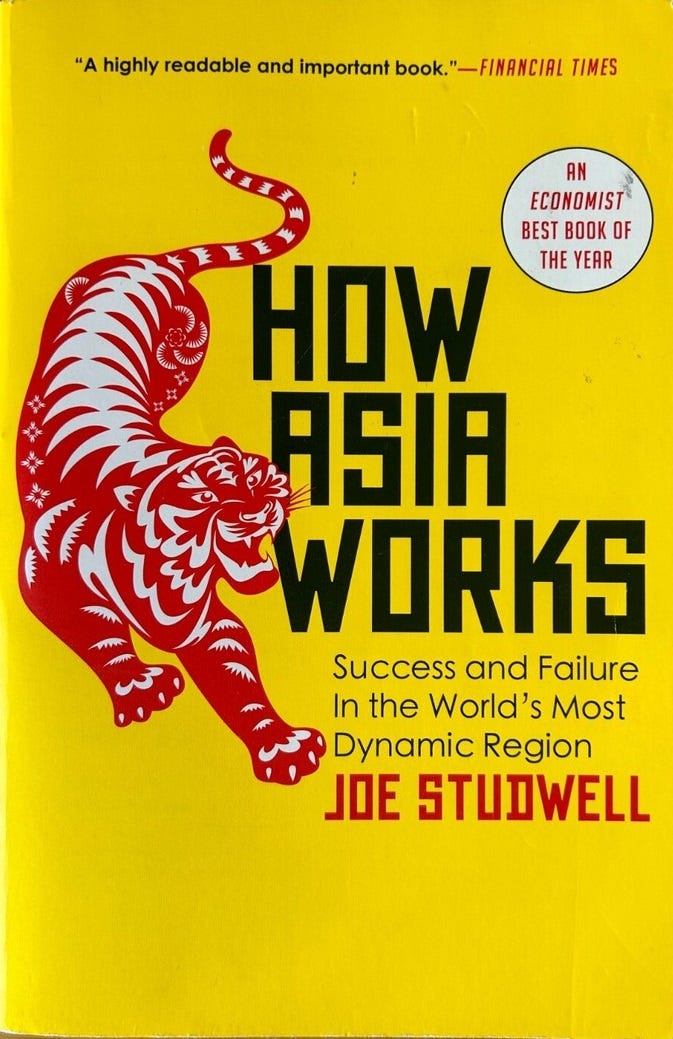
How Asia Works: Success and Failure in the World’s Most Dynamic Region - Joe Studwell
This book looks at how Japan, South Korea, and then China successfully industrialized using the same economic model of state guidance and cultivation of export oriented industries, namely auto manufacturing, electronics and more. Studwell begins with the post-war Japanese economic miracle, analyzes how it is was successfully engineered by the Japanese state in cooperation with companies such as Mitsubishi, Toyota and others, and then how South Korea copied this model, and then how China later copied it as well following Deng Xiaoping’s market reforms.
One aspect of East Asia’s success which Studwell emphasizes is that the national governments of Japan, South Korea and China played a very active role in the process. In each case, a number of firms were given subsidies and others forms of assistance, and then subjected to ruthless competition among each other to see which would emerge as industry leaders in both domestic and international markets. For example, the South Korea auto industry initially began with a large number of firms which over time were either disbanded or merged with other more successful companies, with Hyundai and Kia eventually consolidating into large industrial titans.
How China and the rest of Asia industrialized is an interesting story in its right, but it is especially relevant for America today, since (re)industrialization has also become a much belated national priority. While the goals are similar, the situation America finds itself in today is of course very different than what Japan, South Korea and China faced during the later half of the 20th century. Unlike the later which were largely poor, young, rural and agrarian, America has a much older and wealthier population and is already developed, albeit with finance and services dominating the economy. Reindustrialization is very different from industrializing for the first time, nevertheless there are lessons in this book which would be very useful for Americans to internalize, namely the importance of state directed industrial policy.
While industrializing, Asian economies did rely on tariffs to protect infant industries, but well placed subsides and close cooperation between private companies and the state were also common. This goes against standard “free trade” and other libertarian dogmas which are especially prevalent on the right wing of American politics, but if America wants to return to being an global industrial leader, it might be necessary jettison such ideas. It was under such libertarian dogmas that the process of deindustrialization accelerated, and as Studwell lays out clearly, the Asians who “stole” American jobs were not encumbered by such dogmas. While it is true that planning on the scale of China’s Five Year Plans or Japan’s MITI is not in accordance with the American way of doing things, such laissez faire thinking may not longer be viable considering the constraints America faces.
To Live - Yu Hua
A novel which follows the fortunes Xu Fugui and his family’s struggles during the chaos of the Mao era, after having lost of their property on the eve of the Communist revolution in 1949. Aside from offering a portrayal of what life was like under Mao, the novel is interesting in how it shows every twist of fate both dooms Fugui and family but also miraculously saves them in the end. For example, at the novel’s beginning he loses all of his wealth while gambling, leaving himself and his family destitute, but when the Communists take over they execute the man who won his property on grounds of being a class enemy. More than that, the story really shows how surviving the cataclysms and upheavals that China periodically faces is in large part a matter of luck.

The Long March: The True History of Communist China’s Founding Myth - Sun Shuyun
As the title indicates, this book presents the factual history of the Chinese Communist Party’s Long March and contrasts it with the how the story is portrayed popularly within in the PRC. It is rather ironic because while the actual history is far less glamorous than the true story, it is in some ways more far impressive than the embellished version.
The Long March was the decisive turning point in the early history of the Chinese Communist Party. In the early 1930s the CCP found itself trapped in southern China, with KMT armies increasingly tightening the noose around the Jiangxi Soviet, the territory that was controlled by the Communists. In 1934 the CCP decided to break out of the encirclement and as a whole, they marched into the interior of China and eventually relocated to Shaanxi province in the north. Not only did this give the party a new lease on life, it set the condition for their future victory over the KMT and the conquest of mainland China after 1945.
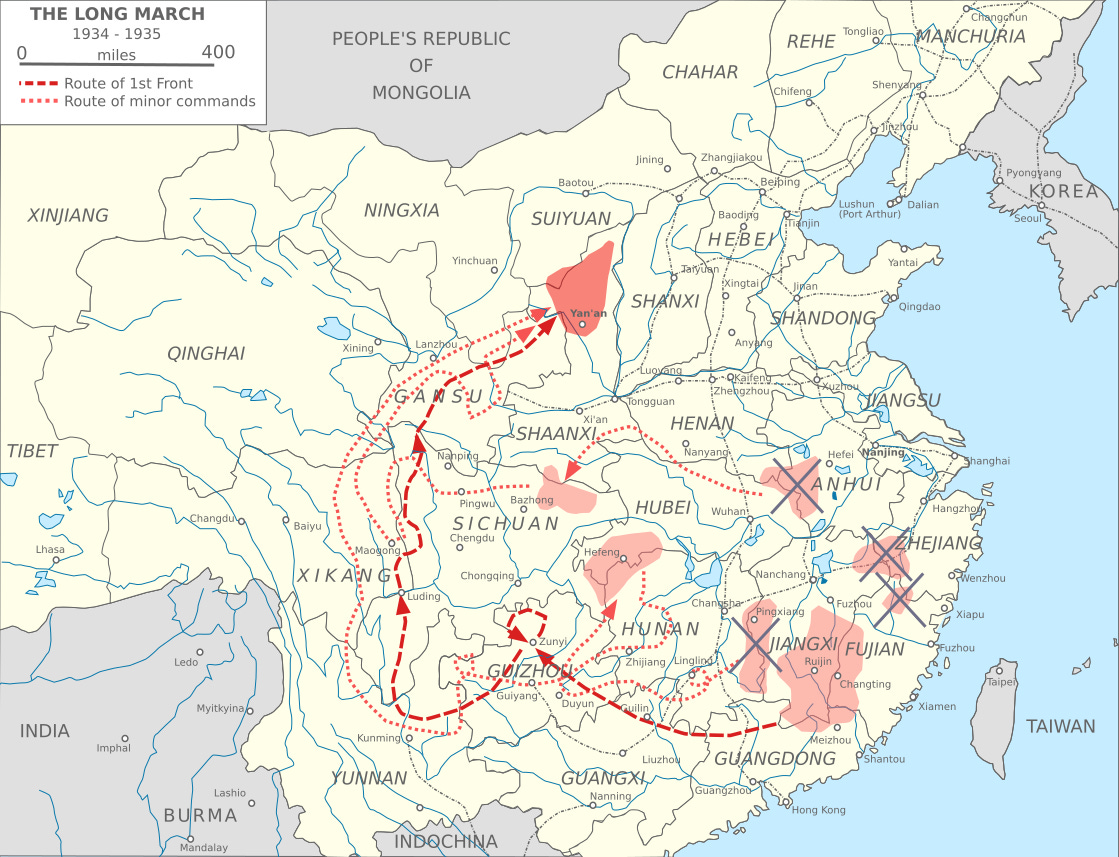
One point of interest in regards to the Long March is the often repeated maxim that China can only be conquered and unified from the north. Historically all of the dynasties which unified China did so from the north, such as the Qin, Han, Tang, Yuan, and Qing, whereas the Song Dynasty and the Republic of China which both originated in the south struggled to consolidate China (the Ming might be an exception to this rule). In the past one of the main reasons for this was that stronger horses and nomadic mercenaries could be more easily sourced in the north, as well as the fact that northern Chinese are more militaristic than southerners. Of course, the CCP did not prevail over the KMT thanks to steppe barbarian mercenaries or cavalry charges, but the relocation to the north did make it easier for the Soviet Union to aid them. Ultimately it was the Soviet occupation of Manchuria in 1945 and the subsequent Soviet aid to CCP forces in the north-east which proved decisive.
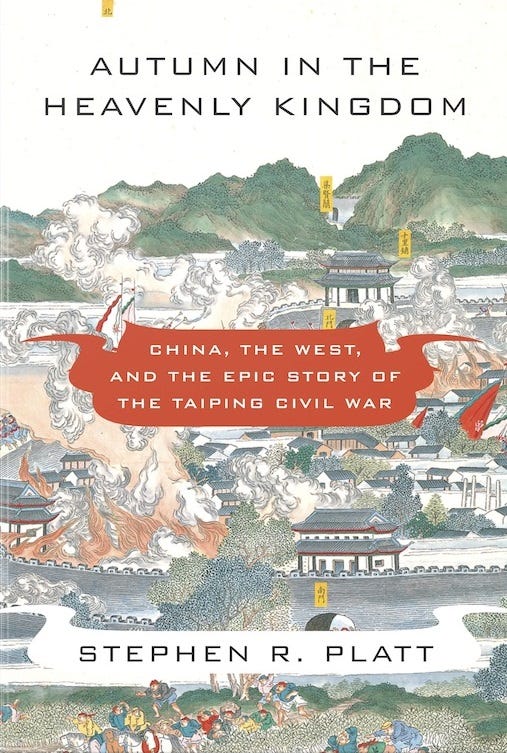
Autumn in the Heavenly Kingdom: China, the West, and the Epic Story of the Taiping Civil War - Stephen R. Platt
Despite being one of the bloodiest conflicts of all time, the Taiping Rebellion remains largely unknown outside of China, especially considering the bizarre milieu from which the rebellion arose. The rebellion broke in 1850 and only ended in 1864, and resulted in the deaths of upwards to 30 million people and fatally weakened the already declining Qing Dynasty. The rebellion was largely concentrated along the lower Yangtze River region, with the core of the Taiping’s territory being the stretch of the river from the western outskirts of Shanghai to Wuhan. The most bizarre detail of all though was that the rebellion was started by Hong Xiuquan, a commoner who after suffering a mental breaking following repeated failures to pass the imperial examination came to believe that he was Jesus Christ’s brother, which was revealed to him in a series of dreams. This belief ideology was mixed a form of anti-Manchu Chinese nationalism and became the ideological basis of the Taiping state.
The Taiping Rebellion is important simply due to the scale and location of the rebellion, but the specific details and its historical context causes it have a profound significance for modern China, as well as shedding light on why the modern Chinese state behaves as it does. In short, modern China’s distrust and suspicion of foreigners and foreign influence can be easily explained by examining the Taiping Rebellion.
First is the issue of religion. In the decades prior the Taiping Rebellion, China had been thoroughly penetrated by European and American missionaries preaching Christianity. This introduction of a foreign faith with radical teachings (from the Chinese standpoint) combined with issues that were organically simmering within the Qing Dynasty produced a truly cataclysmic war, with the former serving as a rallying point for the later. This is naturally something that the modern Chinese government does not want to see repeated in any form, and thus, as is well known today, the PRC has very strict laws regarding religion. Proselytization in China is largely illegal, and what religion that does exist is heavily monitored and regulated. Many heterodox religions are also outright banned and involvement with them is criminalized. The government fears that these movements could serve as a mobilizing force for Chinese who are disaffected and discontent, and ultimately result social destabilization similar to what the Taiping caused.
Foreign religions such as Christianity and Islam are especially controlled, as they are seen as being vectors of foreign influence and Trojan horses for foreign infiltration and espionage. When one considers the history of Christian missionaries in Asia, dating back to the Jesuits of the early modern period or the spread of Islamism today, the Chinese concern can hardly be said to be unfounded. Christianity and Islam are undeniably subversive religions that totally transform societies which they gain ascendancy in, and the Chinese state views it as being undesirable to subject itself to such radical transformations by outside forces. And while Islam and Christianity are allowed in China in an albeit regulated manner, some heterodox varieties of these religions are outright banned. For example, there is a contemporary Chinese Christian sect known as the “Church of Almighty God” which believes that Jesus has reincarnated as a Chinese woman. From what I understand, this sect was made illegal following a stabbing incident in a McDonald’s. History rarely repeats itself so exactly, but nevertheless, considering how the bizarre teachings of Hong Xiuquan spiraled into a massive conflagration, it is not surprising that the modern Chinese state looks unfavourably upon such movements.
The most famous example of Chinese heterodox religions is Falun Gong. It is worth noting that at first the Chinese state took a not at all unfavorable view towards the movement, and from what I understand Falun Gong teachings were even promoted initially by the state to the some extent during the 1990s. This all changed in 1999 following a large protest of Falun Gong members numbering in the thousands at Zhongnanhai, the former imperial palace located just west of the Forbidden City in Beijing which today is the residence of China’s upper leadership. Having violated one of the most important norms in Chinese politics, which that all and any popular mobilization can only be done by the party, and fearing that the movement had turned anti-state, the Chinese government cracked down on Falun Gong and eventually forced what remained of it to go into exile. Since then, Falun Gong has almost certainly cultivated a relationship with American intelligence organs and controls a large network of media outlets that regularly publish anti-China content. It is also worth noting that many of these media outlets such as the Epoch Times and others are aligned with right wing and pro-Trump forces in American politics, groups and individuals who are very well known as being China hawks. MAGA and Trump aligned figures such as Steve Bannon and Peter Navarro are objectively some of the most anti-China people in American politics. Thus, whether the Chinese state’s initial hostility towards Falun Gong was justified or not, it’s current opposition to the movement certainly is.
Aside from foreign and heterodox religious movements, the Taiping Rebellion also resulted in major foreign intervention, namely the Second Opium War where an Anglo-French force captured Beijing, the Qing Dynasty’s capital, in 1860. From the Chinese standpoint, the rebellion along the Yangtze River gave European forces the opportunity commit further predation against China. In other words, an internal crisis gave hostile foreign forces a window of opportunity to act. To add further insult to injury, the threat posed by England and France forced to Qing government to turn to the Russian Empire for assistance, and in exchange for assisstance the Qing Dynasty had to cede Outer Manchuria to Russia, territories which became known as the Russian Far East. Moreover, the Second Opium War ended with further concessions being given to England and France, which only weakened China’s sovereignty and placed if further into a de facto colonial relationship with the European Great Powers.
Thus we see how a local rebellion ideologically fueled in part by a foreign religion eventually resulted in the Chinese capital being captured and sacked, a vast expanse of territory being ceded to a foreign power and China’s further reduction to that of a European quasi-colony. Putting one’s personal views aside and considering the events which transpired during the Taiping Rebellion objectively, it is not all surprising that the Chinese state attempts to a certain extent to hermetically seal China off from the rest of the world by limited the ability of foreign people and foreign information to enter China, in addition to other measures. China is very large country which is very difficult to manage and keep united. It is a vastly more diverse and heterogeneous country than most people realize.
The effort to hermetically seal China off from the world is something that can be seen repeatedly throughout Chinese history, and was always done in order to ward off regional unrest and internal destabilization. For example, China has always maintained a strict and regulated visa regime for foreigners and the state periodically launches campaigns to suppress foreign religions. In fact, the An Lushan Rebellion from the mid-8th century has many parallels to the Taiping Rebellion, including destabilization by excessive cosmopolitanism and foreign intervention. It has also been argued by some that the Great Wall was built in part to keep Chinese in, and prevent them from either fleeing or cooperating with the nomads. Either way, the fear that the nomads would encourage regional, centrifugal forces to act contrary to the capital’s wishes, or even to rebel. Yet at times this seal is broken and outside influence floods into China, which can have revolutionary consequences, as can be seen with the Taiping Rebellion.
In conclusion, not only is Platt’s book very interesting in its own right, the story that is tells helps shed quite a bit of light onto why the contemporary Chinese state behaves as it does. Analysis which chalks state policies up to insanity by the leadership or mere “authoritarianism” is lazy in the extremely and should be ignored entirely.
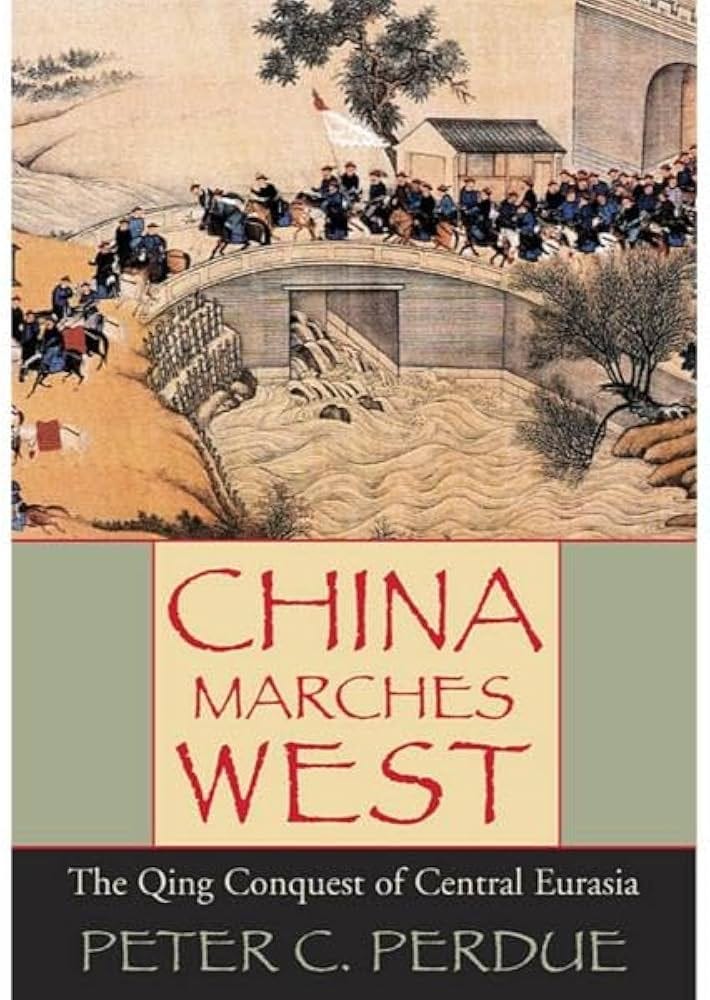
China Marches West: The Qing Conquest of Central Eurasia - Peter C. Perdue
This is a book that I have recommended often, and as time goes on I realized just how foundational it was and how many windows to opened to me, in terms of historical topics. The book is divided into two parts, the first being a narrative history of how China’s Qing Dynasty conquered Mongolia, Tibet and Xinjiang in the process of battling the Zungar Mongols, the last nomadic empire of the steppes. The second half is analyzes how the Qing Dynasty consolidated those territories and incorporated them into the empire.
The main value in this book is that it explains how and why the Qing Dynasty conquered its “Inner Asian Frontiers,” to borrow a term from Owen Lattimore. The principle source of conflict between the Qing Dynasty and Zungars was control of the Mongols. At first the Qing brought the eastern Mongols under its sway, and later Tibet was conquered, since the Mongols had in previous centuries converted to Tibetan Buddhism and it was necessary for Beijing to control the Mongols’ spiritual capital in order to also control them politically. In the end, the Qing invaded the Zungar homeland of northern Xinjiang, the steppe land between the Tianshan Mountains and the Altai Mountains, and soon after occupied the Tarim Basin as well. This process was completed by the late 1750s, and ever since Inner Asia has been apart of the Chinese state, a fact which is of profound importance today.
It is large part thanks to victories of the Qing Dynasty in the 18th century that modern China is the Great Power that it is today. First of all, the aforementioned territories function as strategic buffers for the core Chinese territory. Control over Inner Mongolia in particular has vital for China’s security. Tibet is important for guaranteeing security for Sichuan and Gansu, with the latter being crucial for controlling Xinjiang, since the primary route from China to Xinjiang runs through the Hexi Corridor. This issue was especially important during the 1920 and 1930s and during the Cold War, when the Soviet Union encroached heavily into China’s frontier regions.
Historically, the value in controlling Xinjiang from China’s point of view was that it denied the steppe nomads access to the urban centers in the Tarim Basin. Without the ability to trade with the cities there, the nomads would be unable to source certain manufactured goods which only sedentary societies could produce, such as grain, tools, textiles, and more. By breaking these trade ties, China would fatally weaken the nomads and force them to trade with China, on its own terms which would invariably come with certain political concessions, such as submission to the Chinese state among other things. Xinjiang no longer has such a strategic importance in modern times, but the region still processes extremely valuable resources that are far less common in China proper and are economically necessary for any truly independent and sovereign state today. For example, much of China’s oil reserves are located in Xinjiang, with Karamay being the center of China’s oil industry. Cotton and a number of other agricultural products such as fruits and vegetables are also mainly produced in Xinjiang. China also used the vast empty spaces of Xinjiang for weapons testing, with the most famous being its nuclear tests at Lop Nor. In short, the region is similar to what California and Nevada are for America, except that Xinjiang it landlocked.
Contrary to what many may believe, and despite its large coast line, historically China has not been a maritime country oriented towards the ocean. Instead, China has always been apart of the larger Eurasia landmass, and to some extent an extension of the steppe. Xinjiang and the Hexi Corridor, both in the past and today, provides China with a window to the rest of Asia. In the past the Silk Road ran through the city states of the Tarim Basin towards Central Asia and the west, and today Xinjiang connects China with the rest of Eurasia via the One Belt One Road initiative. This has immense strategic significance. In a scenario where America attempts to impose a blockade on China and cut off its access to the maritime shipping, it will still be able to import some of the resources it needs overland through Xinjiang. Moreover, it is possible that some portion of Chinese-European trade will increasingly be able to be shipped overland across Russia and Kazakhstan via the Khorgos dry land port.
It really must be emphasized that China’s recent turn towards to the oceans is very much a modern phenomenon, and potentially only a temporary one, depending on how global trade and geopolitics develop going forward.
Autumn in the Heavenly Kingdom was great. I recommend the book Bully of Asia to anyone that asks
This was very interesting. ESP appreciated the commentary on the Taiping Rebellion and how that shapes the CCPs policy even today. Thank you! PS: “To live” was made into a great movie. It is one of Zhang Yimou’s best movies and features a young Gong Li